What He Really Means When He Says "I'm Just Really Busy with Work Right Now"

You probably already know something is off, or you wouldn't have searched for this. So we'll skip the part where we pretend the message might be benign.
Here's the version of it you got, more or less:
Yours might say "swamped" instead of "insane." Yours might mention a meeting. Yours might come after three days of silence, or seven, or after one great date and then nothing. The wrapper changes. What's underneath the wrapper doesn't.
If this is the genuinely first time he's said this in an otherwise consistent dynamic, there's a real chance work is just bad right now. People have bad months.
If it's the third time this quarter. If it follows a pattern of him going quiet, surfacing with a vague apology, getting some of your attention back, and receding again. If you can plot the cycle on a calendar. Then it's not a logistics update. There's a name for what's happening, and your gut already knew before you started reading.
This piece walks you through what's underneath, the way a relationship analyst would read the message, and the psychology that makes specific kinds of men send specifically this text in specifically this way.
What it won't do is hand you the exact reply to send. There's a reason for that, at the end.
What Your Brain Is Doing With It
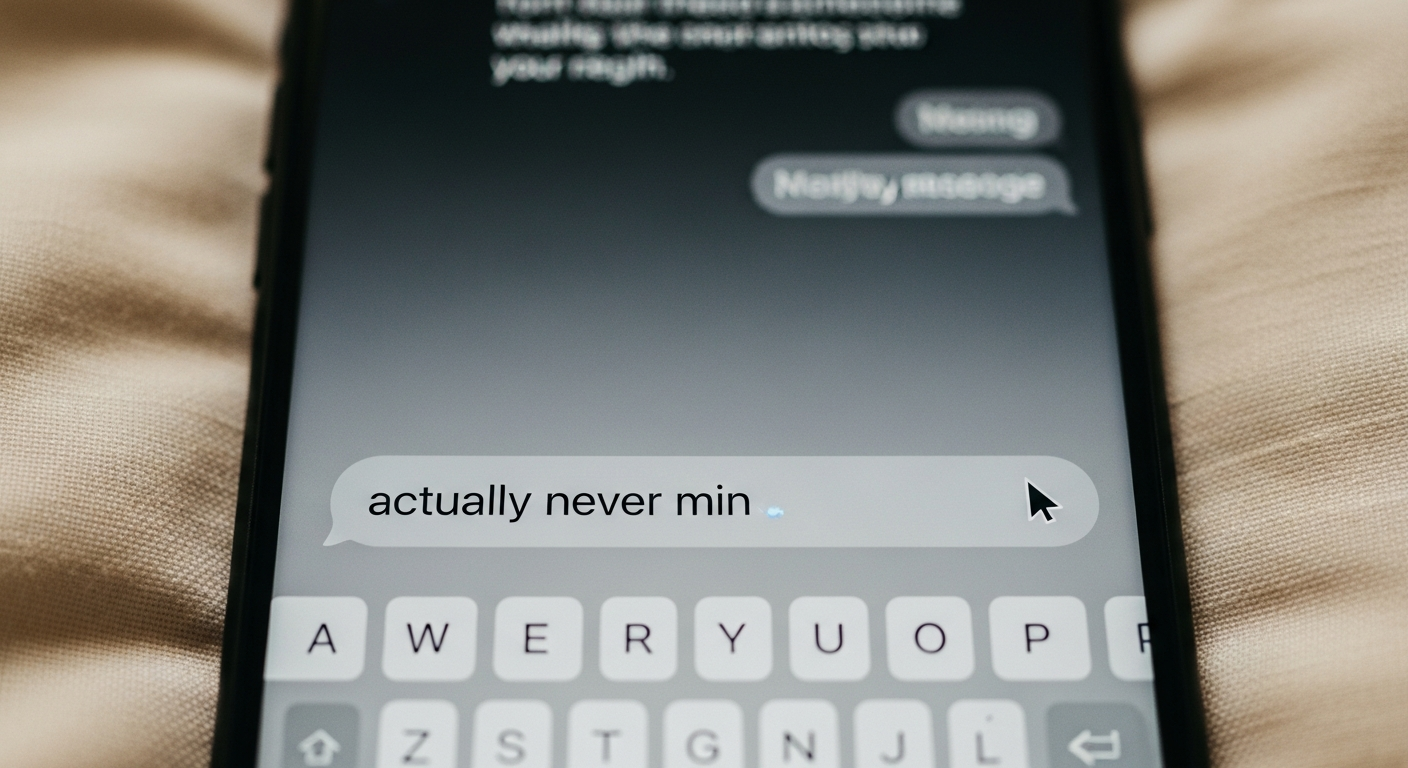
The honest part first. Sarah, a friend, got a version of this text on a Tuesday at 10 PM. By Wednesday afternoon she'd:
Re-read it nineteen times looking for warm signals (the soft emoji, the "sorry," the absence of a period at the end). Drafted a reply that was casual and supportive, then a reply that was casual and slightly cold, then deleted both. Checked his Instagram, found a story posted at 8 PM that night with three of his friends in a bar, and felt the bottom drop out. Asked her group chat to interpret. Got three different interpretations and panicked harder. Wondered if she should send him a meal. Wondered if she should "match his energy" with silence. Convinced herself he was about to ghost. An hour later, convinced herself he was just busy and she was being insane. Re-read the text. Started again.

If most of that lands, your nervous system is doing what it's evolved to do. The spiral isn't a flaw. But the spiral is the thing that needs solving here, not him. Because the loop will run for as long as he leaves you in it, and at some point you'll send a text from inside the loop that you'll wish you hadn't.
"I have this pattern with men. I'm starting to feel kind of stupid because I only get involved with guys like this -- the ones who don't really like me."
That's the specific thing the spiral is engineered to produce: not just confusion about him, but a slow self-indictment. The text is structured to make you feel like you must be doing something wrong, because if he were really into you, he wouldn't go quiet, would he? The honest read is the opposite. The men who behave consistently are not consistent because of something the women they date did or didn't do. They're consistent because that's how they treat people. The men who run hot-and-cold-and-then-vague-and-then-warm again behave that way with everyone. You are not the variable.
How a Decoder Reads It
Here's what the read looks like:
We'll get to one general principle at the end. The specific reply -- the one that fits your situation, not a template -- is what the app does.
The Psychology, Briefly
The technical name for this in attachment research is a deactivating strategy. (Mikulincer & Shaver, Attachment in Adulthood, 2007.)
The mechanics, simply: some adults learned in childhood that closeness, past a certain threshold, isn't safe. Not consciously -- it gets wired in. As an adult, when intimacy starts to feel like too much, an internal alarm goes off. They don't experience it as anxiety; they experience it as needing space, being overwhelmed, not having the bandwidth right now.
The reason "work has been insane" is the most common script for this isn't a coincidence. It's a socially unimpeachable reason for distance. You can't push back without sounding needy. He's not breaking up with you. He's not technically pulling away from you, either -- he's pulling away from a generic stressor. The structure makes any pursuit on your part feel disproportionate.
A few things worth knowing:
It's not specifically about you
Someone running a deactivation cycle would be doing roughly the same thing with anyone they were getting close to right now. The trigger might have been a specifically good date, or something vulnerable you said that landed harder than he expected -- but the response was already wired in his nervous system long before he met you.
He's not playing a strategy
Not the way that phrase usually means. He's not deliberately keeping you on the hook. The distance comes from the older part of his brain. The "work has been insane" comes from the newer part scrambling for a plausible explanation. From the inside, he probably feels honest.
The pattern doesn't fix itself if you wait patiently
Deactivation runs because the other person waits patiently -- that's what makes the strategy succeed. If you wait, he gets to come back when his system says it's safe, which can be days or months. Things only shift when reality intrudes -- when the situation forces a real choice.
The One Principle That Always Applies
Across every variation, every guy, every context, there is exactly one piece of advice that holds:
Do not send him support.
Don't mail him a coffee gift card. Don't send the "hey just thinking of you, hope work eases up soon" text. Don't offer to bring him dinner. Don't tell him you understand and you'll be here when he's ready. All of those moves, however well-intentioned, communicate the same thing: I will absorb this and be available whenever you choose to come back, on whatever schedule works for you. Which is the exact dynamic that lets the cycle run for the next six months.
Anything beyond that -- whether to reply at all, with what tone, on what timeline, whether to address the distance directly, whether to offer one specific plan, whether to disengage entirely -- depends on details only you have. The right reply for someone you've dated 5 weeks who has done this twice is not the right reply for someone you've dated 8 months who's never done it before. There's no universal script.
If you want a read on your specific situation, paste the last 5 messages into the tool below. It'll tell you what cycle phase you're in, what he's likely to do next, and what reply most fits your dynamic, not a generic Option A. Free, takes 30 seconds, private.
We can't make him text back. But the gap between sending a reply from inside the spiral and sending one from outside it is the difference between three more weeks of this and an actual decision.
A Note on the 5%
Sometimes -- not often, but sometimes -- a man really is in the worst work month of his life and the message is exactly what it appears to be. The tell is usually that the rest of his behavior over the previous months has been steady, and the busy-with-work text is genuinely unprecedented for him. In that case, brief warm acknowledgement, no escalation, things go back to normal in 1-3 weeks.
The 95% case is the one this article is about. If the patterns above kept landing as you read, your gut is probably right. The thing left to do is not argue with your gut.
Not sure what his text means?
Paste what he sent you. AI tells you what he actually means.
Free. No sign-up.
Stop Overthinking. Start Knowing.
Paste his text, get the truth. Red flags, mixed signals, what to say back -- all in one app.
Download Overthink