What He Means When He Texts "Hey Stranger" After Weeks of Silence

Most women who paste this specific text into our app have one thing in common: they opened the chat within thirty seconds of the notification appearing. Whatever they were doing -- working, cooking, trying to sleep -- stopped.
That reaction isn't weakness. It's exactly what the text was engineered, by his nervous system, to produce.
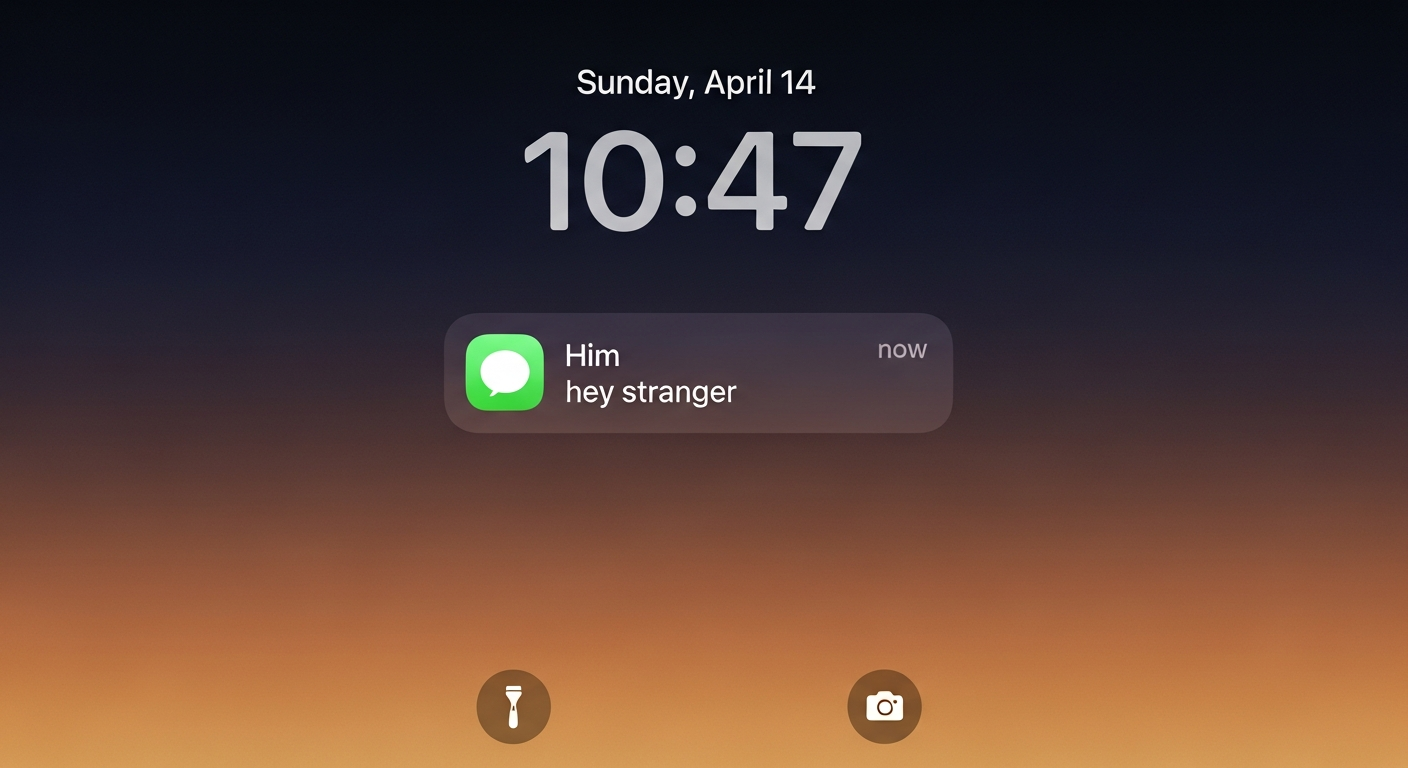
Here's the message in its most common form:
Sometimes it's "hey you," sometimes it's "long time," sometimes it's "was just thinking about you." Sometimes it comes with a meme instead of words. The wrapper changes. What's underneath is remarkably consistent.
This piece walks through what a three-word text actually accomplishes for the person sending it, why you're the last one he sends it to (and why that matters), and the specific thing you need to not do in the first twenty minutes after it arrives.
What's Actually Happening on His End
The temptation is to read the text as "he's been thinking about me, he misses me, he reached out." This reading is technically not wrong -- something about you did cross his mind. But it leaves out the more important question: what specifically made him reach for the phone in this moment, and what does he expect to happen next?
There's almost always a proximate trigger. A quiet Saturday night. A date that fell through. A breakup with whoever he was prioritizing for the last three weeks. A moment of boredom with someone new. Something in his life opened up a slot he used to fill with you, and before he'd fully decided what to do with the slot, his thumb was already on the send button.
He doesn't want a relationship. He hasn't changed his mind. What he wants is to see if the door you left open is still open, without committing to walking through it. The "hey stranger" is a probe -- it tests your availability without risking anything on his side. If you respond warmly, he has the option. If you don't respond, he lost nothing (he never technically asked for anything). The text is free for him to send, which is exactly the problem.
How a Decoder Reads It
The general rule is at the end. The specific move for your version of this -- the one that fits who he was and where you are -- is what the app does with the actual context.
Why You, Specifically
It helps to know that you are almost certainly not the only woman receiving a version of "hey stranger" tonight. Men who send this text send it to a list. Not always a long list, but rarely a list of one.
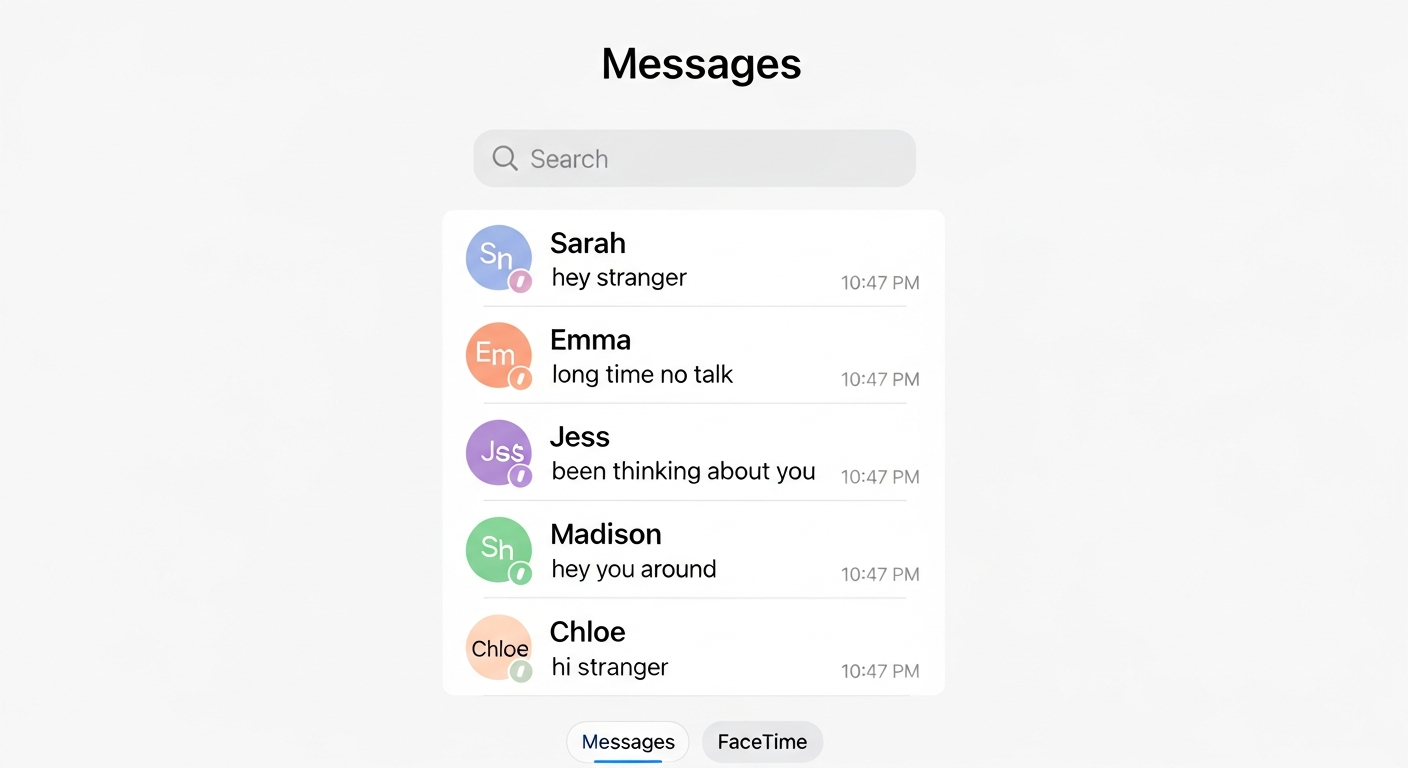
The psychology behind sending to multiple people simultaneously is efficient from his side: one generic, low-effort opener, a dozen or so targets, whoever engages first gets the evening. This is not a conspiracy theory -- it's the rational design of a re-emergence message sent from a state of boredom. The phrasing has to be generic because it has to fit everyone he might send it to. The timing is late evening because that's when boredom peaks. The lack of specificity is the mechanism, not an accident.
This isn't a reason to feel degraded. It's a reason to understand what kind of interaction you are being invited into. You aren't being invited to restart a relationship. You're being invited to fill a slot that opened up in his weekend, and the slot will close again when someone more convenient appears.
"He went quiet at 2am mid-conversation. Then this morning, totally normal text about his neighbor's cow, like nothing happened. What is this."
This is what the next morning of a "hey stranger" exchange almost always looks like. The text comes back not as an apology, not as a continuation of last night's intimacy, but as completely banal small talk -- as if last night was already a very long time ago. The banality is doing the same work the original "hey stranger" did: maintaining contact while resetting the emotional baseline to zero. Each text he sends after the initial probe is calibrated to keep you in his life without escalating it.
The Psychology, Briefly
The technical name for why this pattern is so addictive is intermittent reinforcement. B.F. Skinner showed in the 1930s that animals -- pigeons, rats, humans -- respond most strongly not to rewards that come reliably, but to rewards that come unpredictably. A lab rat that gets food every time it pushes a lever gets bored. A rat that gets food on some lever pushes, and not others, pushes the lever constantly. The uncertainty is the hook.
Relationships that run on this pattern use the same mechanism. The rare, unpredictable text lands harder than a reliable one. Three weeks of silence followed by "hey stranger" produces a dopamine response that a normal, steady, "hey what are you up to tonight?" never could. Your brain is literally wired to pay more attention to the inconsistent man than the consistent one -- because inconsistency looks, biochemically, like a scarcer and therefore more valuable resource.
This is useful to know because the feeling of "oh my god he's back, this is going to be different this time" is not a signal from your intuition. It's a signal from your reward system responding to the intermittent schedule. Your gut isn't telling you anything has changed; your dopamine is.
Three things worth knowing:
The absence has a training effect
Three weeks of silence, then a text that makes you feel special, then silence again, is a classic variable-ratio conditioning schedule. Your baseline nervous system state gradually shifts toward "I am only okay when he texts me," and any interruption to that schedule feels like withdrawal. You don't miss him specifically -- you miss the hit.
The text itself is often better than he is
A well-constructed "hey stranger" with good timing can feel like a personalized, witty reconnection. It isn't. The fact that it hit you hard says more about how long you've been waiting for it than about how much thought he put into it. He spent four seconds writing it. You'll spend four hours interpreting it.
The pattern rewards you for staying
Each time you respond and get another hit of attention, your brain encodes "staying receptive to him paid off this time." Over months, this creates an increasingly strong belief that he'll eventually come back for real, even as the actual evidence says otherwise. The belief is the trap, not him.
The One Principle That Always Applies
There is one rule that holds across all versions of this text, regardless of context:
Do not match his casualness.
The worst response, worse than anger, worse than silence, is "hey stranger back lol." Matching his casual energy says one specific thing: "I accept the terms of this interaction -- that we can disappear for weeks and come back with a wink and no accountability." You didn't mean to say that, but that's what got communicated, and he will calibrate his next move accordingly.
This doesn't mean you need to be confrontational. You don't have to send "where the hell have you been." You don't need to make a speech. But if you reply at all, reply as if you're the person you were before he disappeared, not the smoother, lighter version of yourself that you think he wants to come back to. If three weeks of silence wouldn't be normal between friends, don't pretend it's normal here.
What that actually looks like in practice -- whether to reply at all, what to say, whether to give him an opening to explain, whether to cut contact entirely -- depends on the history he's earned with you. Someone you dated for four months who ghosted after sleeping with you requires a different response than someone you had three dates with who faded. A pattern that's repeated four times is different from a pattern that's happening for the first time. What you want from the next month is different from what you wanted six weeks ago.
If you want a read specific to your situation, paste the last few messages into the tool below. You'll get back what cycle you're in, what he's likely to do in the next 72 hours, and the reply that actually serves you instead of keeping you on his rotation.
The Uncomfortable Question
The question worth sitting with isn't "should I reply." It's: what do I actually want the next three months to look like?
If the honest answer is "I want a real relationship with this specific person, and I think there's real potential that he's ready now," then a specific direct response (asking for a real plan, asking for an acknowledgement of the gap) is reasonable -- but know that you'll have your answer within 48 hours, because men who are actually back make real plans quickly.
If the honest answer is "I miss the feeling of him being interested, more than I miss him specifically," then what you're responding to is the dopamine schedule, not a person. That's important information, because the thing you're missing isn't something he can give you by coming back. It's something the pattern itself has taught you to need.
Either answer is usable. The one that doesn't work is answering "hey stranger" with another "hey stranger" and hoping this time the loop ends differently. It doesn't, because nothing about the setup has changed. He sent the same text he always sends. The thing that has to change, if anything is going to change, is the reply.
Not sure what his text means?
Paste what he sent you. AI tells you what he actually means.
Free. No sign-up.
Stop Overthinking. Start Knowing.
Paste his text, get the truth. Red flags, mixed signals, what to say back -- all in one app.
Download Overthink