What "I'm Not Ready for a Relationship Right Now" Actually Means

I want to start with the part that's least comfortable to admit: I'm the founder of Overthink, and I've sent some version of this text. Not exactly this one. Mine was longer, mine had more apologies, and I told myself at the time it was the kind thing to do. It was not.
Most of the writing on this site comes out of an editorial voice we call Maya. This one I'm writing as me, because I think the read on this particular sentence is more useful from the inside than the outside.
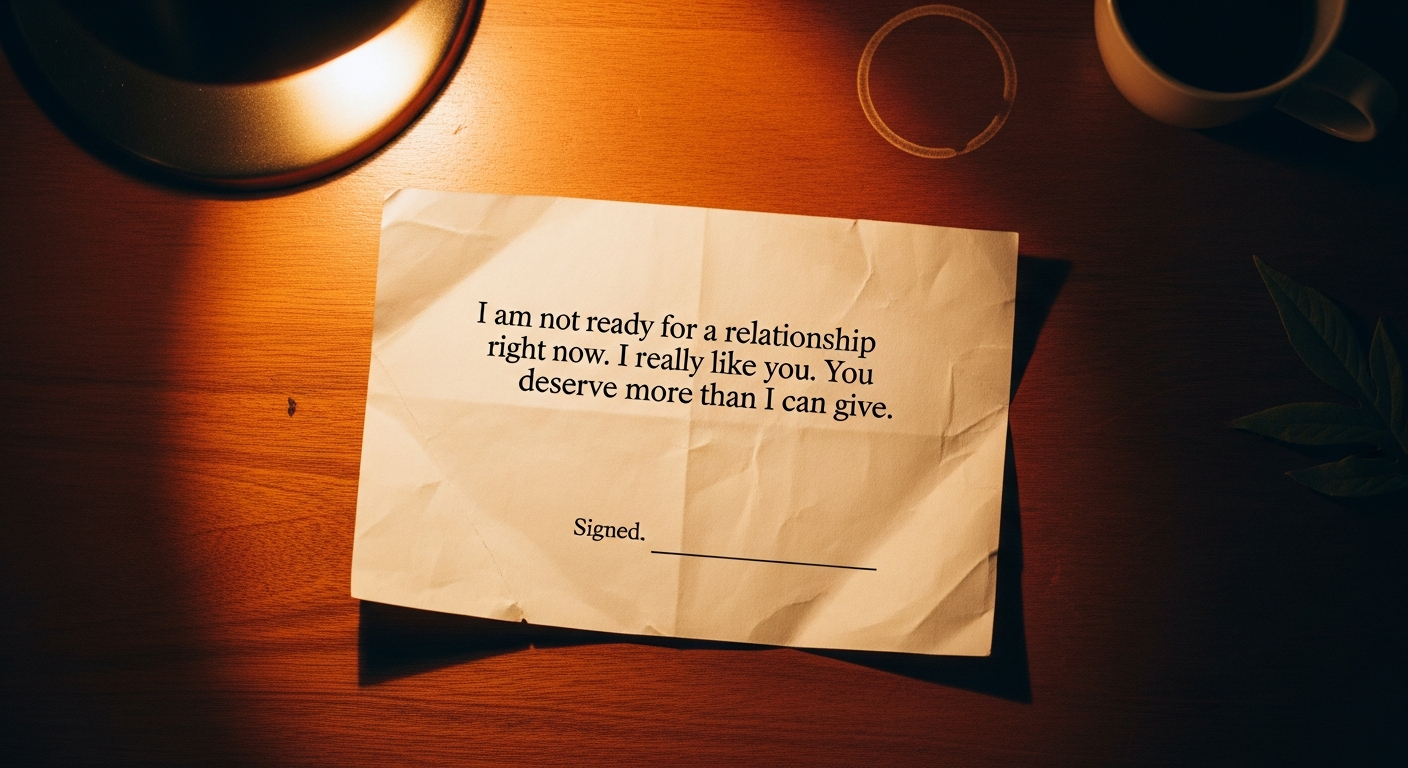
Here's the message, in roughly the form most women paste into our app a few hours after receiving it:
The thing I want you to understand is that this sentence is almost never literally true. I have been ready for relationships before. The men sending you this version of it have been ready for relationships before too. We are not waiting for some inner readiness to descend like a religious vocation. What we mean -- what I meant, when I sent mine -- is one of three other things, and which of the three it is can usually be identified from the context around it.
What I Was Actually Doing When I Sent It
I'll tell you the part that took me years to be honest about: I sent the text not because I had figured something out about myself, but because I felt the relationship moving toward a place where I would have to make a real decision, and I wanted to delay that decision indefinitely. The text gave me a way to do that without seeming like a coward.
That's the engineering of it. It looks like vulnerability. It feels like vulnerability when you're sending it. But functionally, it pre-licenses every avoidant move I might make for the next six weeks. If I disappear for a week, I told you I wasn't ready. If I keep texting you but never make plans, I told you I wasn't ready. If I see someone else, I told you I wasn't ready. The sentence is a permission slip I write for myself, before you've even raised an objection.
The cruelty is that it's framed as honesty. And so any pushback you might give -- any question, any "wait, but," any boundary -- gets to be reframed as you not respecting my vulnerability. I've watched myself do this in real time. It's not subtle when you can see it from the outside. From the inside, it just feels like I'm being a good guy.
What it sounds like from your side, in the hours afterward, is something close to this -- a real exchange a user pasted into our app, translated from Portuguese:
"Should I just ask him directly if he's interested?"
"Will that seem desperate?"
If you've been there: those are the wrong two questions, but they're the questions the text is engineered to produce. Not because you're foolish for asking them. Because the sentence transferred the entire emotional load of the relationship from him onto you, and now you're the one carrying it. He gets to feel honest. You get to feel desperate for wanting clarity.
How a Decoder Reads It
The general principle is at the end. The actual reply -- the one that fits your situation -- is what the app does with the surrounding context.
The Three Things I'm Usually Doing When I Say It
There are three real translations of "I'm not ready for a relationship." I've been the guy in all three of them at different points. Which one applies in your case is usually identifiable from the context around the sentence itself, not the sentence itself.
1. "I want the access without the title."
The most common version, including the version I sent. I liked spending time with her. I liked the sex. I liked that she was around. I didn't want to commit to monogamy or to taking the relationship to its next stage, because committing would have closed off the option of someone better appearing -- and on some level I was still scanning. By telling her I was "not ready," I got to keep enjoying everything I was enjoying with one critical change: I no longer owed her any movement forward. The texts continued. The plans continued. The intimacy continued. The relationship just didn't.
The tell: nothing about the day-to-day actually changes after this conversation. He still wants to see you. He still wants to text. The only thing missing is the future.
2. "I want to slowly let this die."
Less common but real. He knows the relationship isn't right but doesn't have the stomach for a real ending. By telling you he's "not ready," he transfers the ending to you -- you'll either accept the offer to become a casual situation, in which case he can drift out over the next 6 weeks with plausible deniability, or you'll end it yourself, in which case he gets to be the honest one who tried.
The tell: enthusiasm visibly drops in the days following the conversation. Texts shorter. Plans deflected. He's not actively pulling away -- he's just stopped pulling forward.
3. "I'm dating someone else and need optionality."
Less common but it happens. He's in a parallel conversation that's progressing, and he needs to keep you on hold without lying outright. "Not ready for a relationship" creates space for him to disappear for the weekend without it being suspicious, and to reappear with no explanation needed.
The tell: the text often comes shortly after a stretch where he was less available than usual, and is followed by another stretch of low availability. The pattern matters more than the words.
A man in version (1) wants you to stay close-but-undefined. A man in version (2) wants you to leave so he doesn't have to. A man in version (3) wants you to be patient. None of us is asking you to wait for his readiness.
The Psychology, Briefly
There's a useful concept from social psychology called pseudo-disclosure -- the act of confessing something true in order to license behavior that would otherwise be unacceptable. Telling your partner "I'm bad at communication" creates a frame in which subsequent communication failures aren't violations, they're just... you being you.
"I'm not ready for a relationship" is a textbook pseudo-disclosure. It's true (he isn't ready), it's framed as honesty (he's being vulnerable), and it pre-licenses inconsistency, distance, parallel options, and the absence of any forward motion. The structure is what makes it powerful, not the content. The same words from a man who'd never seen you again would be unremarkable. The same words from a man asking to keep you in his life are doing real work.
The reason this is hard to push back on is that any objection sounds like you're punishing him for telling you the truth. "I told you where I was -- what did you expect?" becomes the eventual frame, even if you didn't actually agree to the new arrangement. You agreed to the relationship he proposed -- what you have now isn't that.
Three things worth knowing:
It's not always conscious
I want to be clear: I wasn't sitting at my desk thinking "let me deploy a pseudo-disclosure." I just knew, on some level, that this was the phrase that would get me what I wanted without the mess. My nervous system found this script the same way yours found the spiral -- through repetition. The man texting you almost certainly experiences himself as honest in the moment of sending it.
"You deserve more than I can give right now" is the manipulative half
The first half ("I'm not ready") is the disclosure. The second half is the soft anchoring -- it puts the dignity of the relationship on you, while keeping the option of continuing it open. A man genuinely walking away says "I don't think we should keep seeing each other." A man trying to convert the relationship into something less defined says "you deserve more."
The text is about the relationship's structure, not about you
Whatever happens in the next 30 days is information about him, not a verdict on you. If he comes back and "wants to try," that's data. If he disappears, that's data. If he stays in your life on the new terms and behaves better than the words suggested, that's also data -- and the rare good outcome.
The One Principle That Always Applies
The single rule that holds across all three versions:
Do not respond with "I understand."
That phrase, in any of its variants -- "totally get it," "no pressure," "take the time you need," "I'm here when you're ready" -- is the move that converts the relationship into the new arrangement he's proposing. It's the explicit acceptance of the new terms, even if it doesn't feel like one to you when you send it.
You don't have to be cold. You don't have to make a scene. But there's a wide gap between "I understand and I'm here whenever" and "I need to think about what I want from this." The first one re-enrolls you in his version of the future. The second one keeps the question open for both of you.
What "thinking about what I want" actually means in your specific situation -- whether to go fully no contact, whether to date other people openly, whether to have a conversation in person, whether to give it 30 days and revisit, whether to walk completely -- depends on details only you have. Length of relationship, what he's done before, what you'd realistically accept, whether you've already been here once with this same person.
If you want a read on your specific case, paste the last 5 messages into the tool below. You'll get back which of the three versions you're probably in, what's likely to happen in the next 4 weeks, and what response actually serves you instead of him.

The Real Question (and What I Wish She'd Asked Me)
The question worth asking isn't whether he'll get ready. He might. He probably won't on a timeline that helps you. In my experience, on both sides of this conversation, the share of men who send this text and then actually become available for a real relationship with the same woman six months later is small enough that planning around it isn't a strategy.
The real question is whether the version of this you're being offered -- the access without the future, the closeness without the commitment, the relationship without the relationship -- is what you actually want. If you read that and felt your stomach tighten, that's the answer. If you read it and felt relief, that's also an answer. Either one is worth knowing before you draft the reply.
The thing I wish, in the version I sent years ago, that she'd asked me wasn't "are you sure?" It was "what specifically is changing for you in the next 90 days that would make you ready?" I wouldn't have had an answer. I would have known immediately that I didn't have an answer. And the conversation would have ended where it actually deserved to end, instead of a slow eight-week drift that hurt both of us.
-- Adam
Not sure what his text means?
Paste what he sent you. AI tells you what he actually means.
Free. No sign-up.
Stop Overthinking. Start Knowing.
Paste his text, get the truth. Red flags, mixed signals, what to say back -- all in one app.
Download Overthink